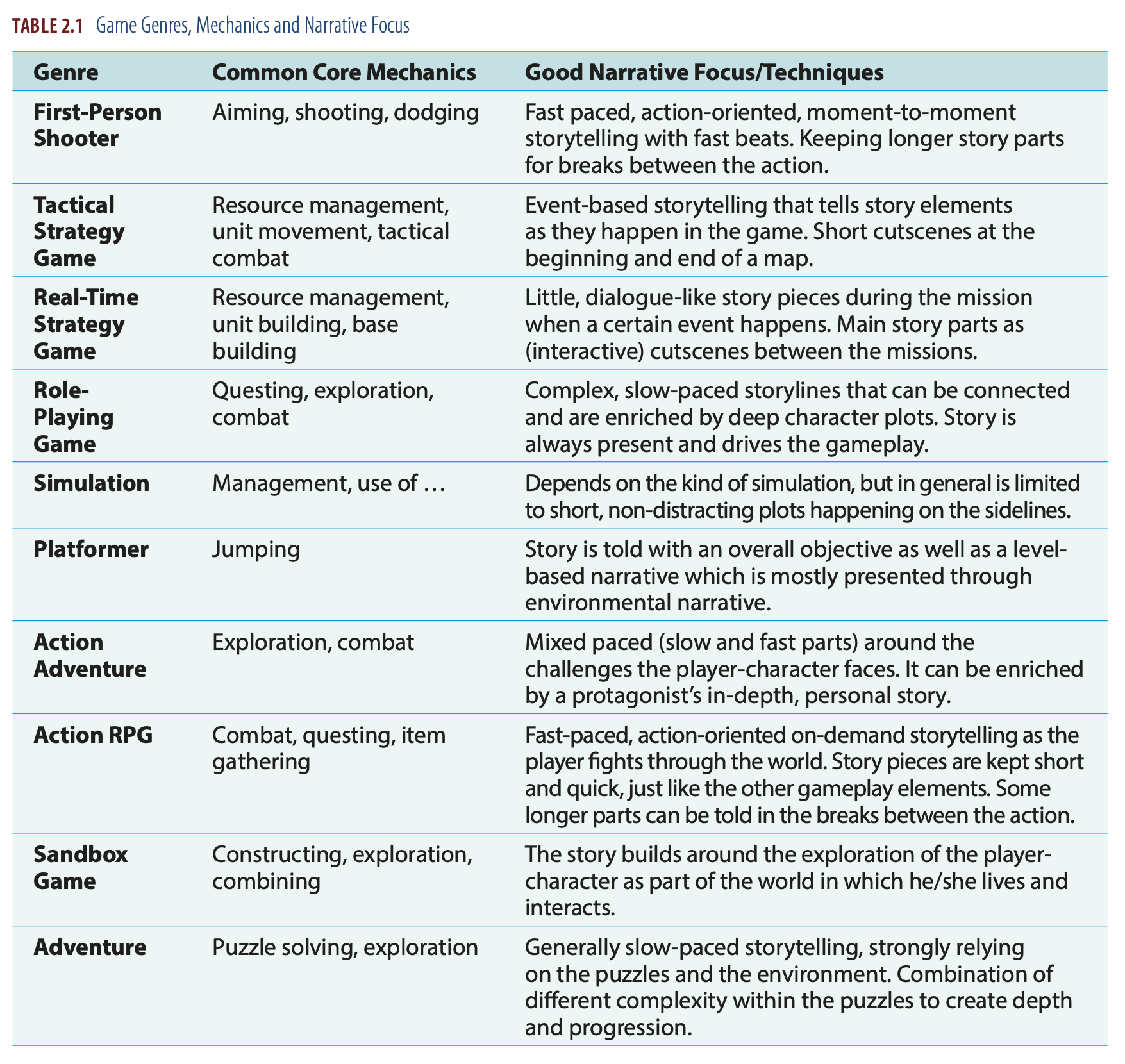
It is possible to divide game narratives into three broad categories, each with their own writing requirements. These are: Linear Narratives, Branching Narratives, and Open Narratives .
A linear game means a game in which every player experiences the same events in the same order, every time the game is played.

While linearity may at first glance seem to work against interactivity, many games tell quite eff ective stories using a linear structure. Many movie- to-game adaptations follow the same linear story as the movie, only in an interactive format. Linear stories rarely use interactive dialogue, as they have no way to respect player dialogue choices. This means that story in a linear game is usually conveyed by a combination of cutscenes and environmental narrative (using level design, supporting characters, and ambient dialogue).
In branching narratives the player makes choices that affect individual sections of plot and gameplay. However, the plots come back together again at pinch points to ensure that the player stays along the path of the overall story
This means narrative designers for RPGs or branching adventure games must consider both the narrative through-line of any individual quest or quest chain, plus how those quests come together into a coherent storyline across the entire game.
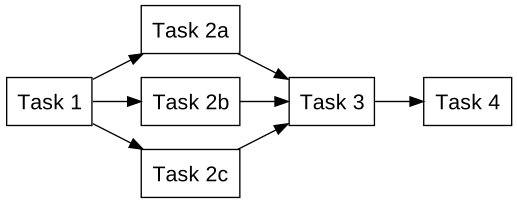
In most RPGs, branching is handled by having numerous quests—up to hundreds of individual quests in a lengthy game—of which the vast majority are optional for the player to complete. Players fi nd these “side quests” by exploring the world and talking to minor characters, and it is of no concern whether they ever even learn of this content’s existence. The string of non- optional quests which the player must complete in order to advance to the next point in the plot is known as the Critical Path, or “critpath.”
Branching narratives are all about giving the player choices. And to respect the player’s sense of agency, that means the game’s design must honor those choices. It is only when the consequences of a choice are seen in-game that the choice becomes meaningful, whether the impact is purely on the narrative, on the game mechanics, or both.
A quest is a single, relatively linear section of story within a larger game, in which all of the player’s actions serve a specifi c goal. When the goal changes, you’ve started a new quest.
The basic structure for an RPG quest is as follows:
Work out the information fl ow early and check back in on it often. If the central storyline is a mystery (“Who killed the king and started the war?”), then fi gure out early how many red herrings and clues you’ll need before you learn the answer, and what players do once they know. Pick one or two large reveals for each critical-path quest, and build the quest around that reveal.
Make the critical path simple, so the parts can all function separately.
Make the goal worthwhile, concrete, and easy to remember. A concrete goal (defeat the evil king) is much easier and more motivating for players than a more abstract one (become popular enough to get elected).
Keep the critical path alive. It’s easy in an RPG lasting sixty hours or more to lose the thread of the critical path. Players play for a few hours at a stretch and care much more about the problem of the moment than what they were told at the beginning of the game (which they might have started months ago). Before signing off on a quest, it’s important to look at how to tie it to the main plot.
Task: Missions vs. Quests
Task: The generic term for any goal a player needs to accomplish through gameplay. Both missions and quests are tasks, but they may involve more than one task to complete.
Mission: A task or group of tasks composing a single part of a linear story , the equivalent of a chapter in a book. Missions are therefore always played in the same order and can build upon each other, with Mission 1 leading into Mission 2.
Quest: A task or group of tasks composing a single, self-contained storyline that may be a part of, or alongside, a larger plot in a non-linear story . Closer to a short story from a themed anthology than a chapter in a single narrative. Quests can be played in varying orders and do not have to aff ect each other or build on each other (though narrative designers can restrict some quests to being played in sequence).
Sandbox games like Grand Theft Auto and many MMOs use a structure that is even more open than a branching RPG, trying for a true non-linear experience, in which players can choose their own order to complete any content.
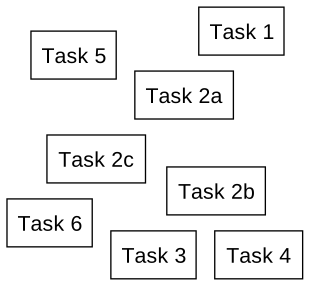
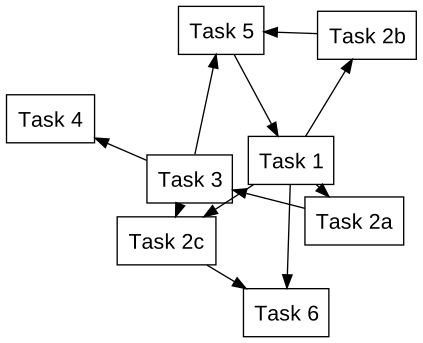
Such an open structure can be a challenge for writers and designers, since a true story can never really be non-linear. Why? Because a story is a directed or ordered sequence of events experienced by one or more characters. A story always has a beginning, middle, and end. This order technically forbids non-linearity. So, how do narrative designers still create a sense of non-linearity in their games?
A good non-linear narrative follows no predefi ned sequence of events. Instead, it is built out of small story blocks that can be triggered once a precondition is met. As a narrative designer, you cannot predict which path a player will take, and all story blocks need to be designed in such a way that they work in an almost free order. Players can choose whatever they want to experience and will create their own story based on their choices. The only real block to stop them from playing everything is character-level requirements, in which designers block players from accessing certain content until their character reaches a specific level. Using these requirements to contain the narrative allows narrative designers to structure the overall story experience, and thus tell a bigger story within a set of freely picked story pieces.